🔍 12 Questions Every Project Contractor Must Ask Before Ordering LED Lighting from China📅 August 31, 2026 | 📂 Procurement Guide | ✍️ Gotall Technology Engineering Team In our 10+ years in commercial and industrial lighting, we have received countless calls from facility managers, contractors, and procurement professionals who purchased LED lighting from overseas suppliers—only to discover that what they received was nothing like what they expected. Fixtures that failed within months. Performance data that didn‘t match real-world results. Hidden costs that doubled the project budget. A warehouse manager who needed to completely re-light his facility because his original supplier didn‘t understand his operational requirements . These are not isolated incidents; they are the predictable consequences of procurement decisions made without asking the right questions. As a LED lighting manufacturer China with our own factory and engineering team, we‘ve seen both sides of this equation. This guide distills 12 critical questions every buyer should ask before placing an order—questions that reveal whether a supplier can truly deliver on their promises.  🔬 Product & Technical QuestionsQ1: Do you have complete-luminaire photometric data (IES/LDT files) for this exact model?Why this matters: Many suppliers quote LED chip lumens—not complete fixture lumens. A 40W fixture with a high-efficacy chip can deliver as little as 70% of the claimed output once optical losses, thermal degradation, and driver inefficiency are accounted for. Generic IES files used for several different products are not reliable for project design . What to look for: Request the IES or LDT file for the exact fixture model you are ordering. The file should show luminaire lumens (not chip lumens), beam angle, candela distribution, and include the measurement conditions. At Gotall, we provide complete photometric data for every fixture—including the lumen output at the specific CCT you are ordering. Q2: What LED brand and drive current do you use—and are you binning the chips?Why this matters: Not all SMD2835 chips are created equal. Reputable LED brands (e.g., Samsung, Nichia, Osram) maintain tight color binning (±3–5 SDCM) and provide reliable L70 curves. Discount suppliers often use un-binned chips from unknown sources, resulting in visible color variation between fixtures in the same project . Driving an LED at its maximum current can also reduce lifespan significantly. What to look for: Ask for the specific LED brand, package type, and operating current. At Gotall, we use SMD2835 chips from reputable manufacturers with SDCM < 5 and operate them below maximum drive current to improve thermal margin and long-term stability . Q3: What driver brand and model are you using—and can you commit to not substituting it after quotation?Why this matters: The LED driver is one of the most failure-sensitive components in any luminaire . Suppliers who switch to lower-cost drivers after quoting a project can dramatically reduce fixture reliability and performance. Cheap drivers often lack over-temperature, over-current, and surge protection, and they fail prematurely in industrial environments . What to look for: Get the driver brand and model in writing. At Gotall, we use Tridonic, Osram, or TCI drivers across our entire product line—and we do not substitute drivers after quotation without written approval from the customer.  Q4: Have you validated the thermal performance of this fixture at the specified ambient temperature?Why this matters: A heavy housing does not automatically provide good thermal performance. In one case, a warehouse manager had to completely re-light his facility because the original supplier‘s fixtures operated at only 15 foot-candles when the picking area required 30 foot-candles minimum—the fixtures had been specified based on chip lumens, not delivered lumens after thermal derating . What to look for: Ask how the manufacturer verifies LED board temperature, driver case temperature, and housing temperature at full power and at the specified ambient temperature . At Gotall, we validate thermal performance across our full operating temperature range (-25°C to +55°C for our industrial tri-proof series), ensuring stable lumen output even in hot warehouse conditions. Q5: What is the IP and IK rating—and is it certified by a third-party lab?Why this matters: Many suppliers claim IP65 or IP67 protection without actually testing it. Inferior products only have simple dust and water resistance—without professional sealing structure and certification, water vapor and fine dust will penetrate the lamp body . This leads to moisture inside the lamp, short circuits, and premature failure . What to look for: Ask for the IP and IK test reports from an accredited lab (e.g., SGS, TÜV, Intertek). At Gotall, our tri-proof lights are IP65 and IK08 certified with full test documentation. For projects requiring higher protection, we offer IP67 and IK10 options with complete certification. 🤝 Service & Support QuestionsQ6: Do you manufacture the products yourself, or are you a trading company?Why this matters: Suppliers who do not own their own factory have limited control over quality, lead times, and production changes. They are also less able to accommodate customizations or resolve issues quickly . What to look for: Ask for a factory tour (virtual or in-person). A genuine manufacturer should be able to show you production lines, quality control stations, and R&D capabilities. At Gotall, we operate our own 3,000㎡ facility in Shenzhen with in-house R&D, SMT production lines, and a dedicated quality testing center. Q7: What is your warranty—and what is actually covered?Why this matters: Many suppliers offer long warranty periods but exclude diffusers, require product to be returned to base at the customer‘s expense, require registration, or have severely limiting run hours . A 5-year warranty is meaningless if the supplier expects you to pay return shipping from Singapore or Australia. What to look for: Get the full warranty terms in writing. At Gotall, we offer a 5-year warranty with straightforward coverage—including components and labor, with clear claims processes for our international customers. Q8: What is your typical lead time—and can you handle urgent orders?Why this matters: Project delays often cascade—a two-week production delay can mean a two-month shipping delay, which can mean missed occupancy dates and penalty clauses. Suppliers with flexible production capacity can accommodate urgent projects when needed . What to look for: At Gotall, our standard lead time is 15–25 days after order confirmation, and we maintain buffer capacity for urgent orders. We also offer sample shipping within 5–10 days for qualification testing before bulk orders. 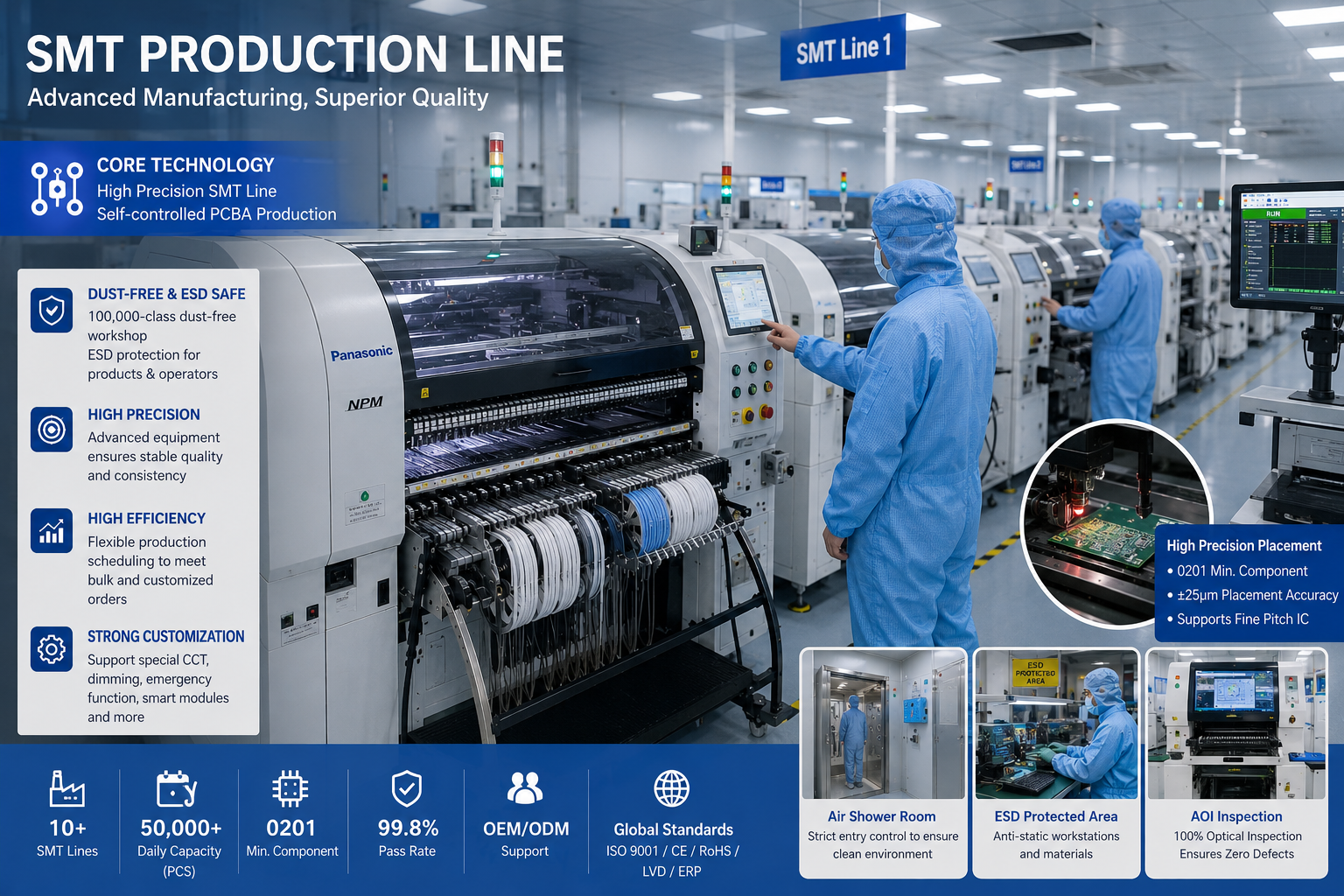 Q9: Can you provide customized configurations—and what‘s the minimum order for custom options?Why this matters: Project requirements often vary—emergency backup, microwave sensor, DALI dimming, specific CCT, or custom wattage. Suppliers who can only offer standard SKUs may force you to compromise on your design . What to look for: At Gotall, we offer a comprehensive range of functional customizations—emergency (3-hour backup), microwave sensor (5.8GHz, customizable holding time), DALI dimming (1-100%), CCT and wattage selectable, and linkable connectivity. We also support MOQs as low as 10 units for custom configurations, enabling you to spec the exact product your project requires . 📋 Compliance & Documentation QuestionsQ10: Do you have third-party certification—CE, RoHS, UL, etc.—for this model?Why this matters: Products that fail customs or authority inspection can cause costly delays. In the UAE, for example, lighting touches several authorities—DEWA, ADDC, Al Sa‘fat, Estidama, and Dubai Civil Defence—and specifying non-conformant product risks customs issues and project delays . Products intended for U.S. installation must meet UL 1598/8750 listing, FCC Part 15 compliance, and RoHS conformance . What to look for: Request the full test reports, not just a certificate image. At Gotall, our LED batten lights and tri-proof lights are CE and RoHS certified (LCSB05065119S for LVD, LCSB05065121E for EMC), and we can provide test reports to support market-specific certifications such as Singapore Safety Mark and Australia RCM. Q11: What spare parts support do you offer—and for how long?Why this matters: A 5-year warranty is only as good as the spare parts availability. Some suppliers will disappear entirely after a few years, leaving you with fixtures that cannot be repaired. Others stock components for only a short period, forcing you to replace entire systems when a single driver fails . What to look for: Ask how long the supplier stocks spare parts for their fixtures. At Gotall, we maintain spare parts inventory for drivers, sensors, and other key components for the life of our product lines—ensuring long-term serviceability for our customers . Q12: Can you provide references from similar projects—in my region and industry?Why this matters: A supplier‘s claims are only as credible as their real-world track record. A manufacturer who has successfully delivered projects in Singapore or Australia understands the voltage requirements (220-240V, 50Hz), local certification requirements, and logistical considerations for shipping to these regions . What to look for: At Gotall, we have served partners in 168+ countries and can provide project references—including our case study on the Singapore warehouse retrofit (38% energy savings, 90-day implementation). 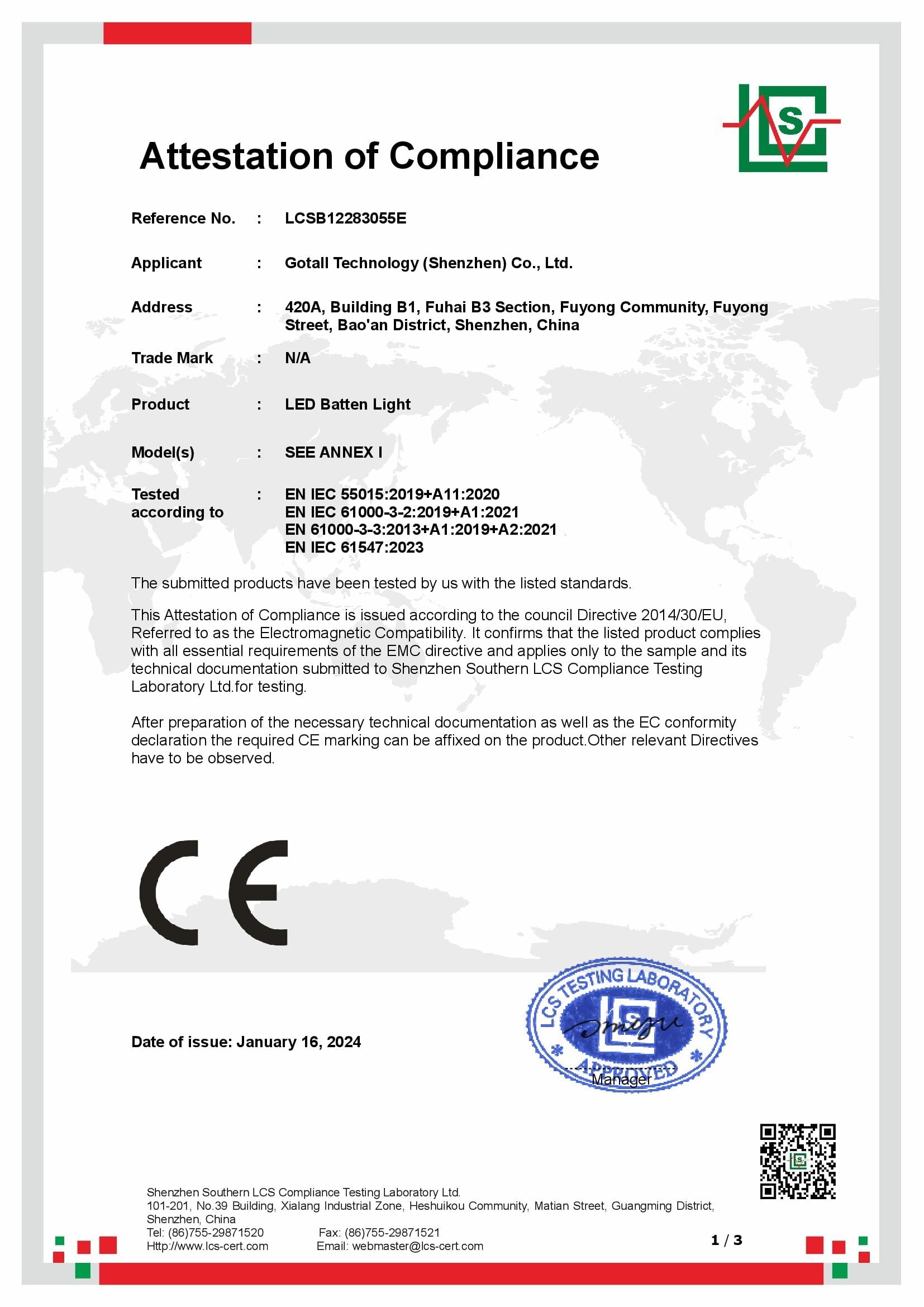 📌 Conclusion: Questions Are Not Suspicion—They Are Due DiligenceAsking the right questions before placing a lighting order is not about distrusting suppliers—it is about protecting your project, your budget, and your reputation. A supplier who cannot answer these questions clearly and transparently is sending you a signal: they may not be the right partner for your project. At Gotall Technology, we welcome these questions because they give us the opportunity to demonstrate what we do best: deliver reliable, high-quality LED lighting solutions backed by engineering expertise and transparent communication. As both a LED batten light supplier and a custom LED tri-proof light manufacturer, we have built our reputation by answering these questions—not just once, but for every project, every order, every customer. We maintain documented processes, complete photometric data, certified test reports, and a responsive service team because we believe that good procurement decisions are built on good information . With over 10 years of industry experience and an on-time delivery record we are proud of, we are ready to help you source the industrial lighting solutions your project deserves. 📩 Ready to start your next lighting procurement? Contact our sales engineering team to get the answers you need.
|
 EN
EN
 AR
AR BG
BG HR
HR CS
CS DA
DA NL
NL FI
FI FR
FR DE
DE EL
EL IT
IT KO
KO NO
NO PL
PL PT
PT RO
RO RU
RU ES
ES SV
SV TL
TL ID
ID LV
LV LT
LT SR
SR SK
SK SL
SL VI
VI SQ
SQ ET
ET GL
GL HU
HU TH
TH AF
AF GA
GA CY
CY IS
IS HY
HY AZ
AZ MN
MN